News
Stay informed with the latest updates on our company milestones, contract awards, technological innovations, and community impacts.

A Notice About Hiring Scams: Verify That It’s Really Us
September 29, 2026Beware of recruitment and employment scams! Got a message claiming to be from Avum? Before you respond, verify the email domain and know what to expect from us.
Some scammers may impersonate Avum, falsely claim to represent Avum, or make their communications appear to come from Avum in order to deceive job seekers.
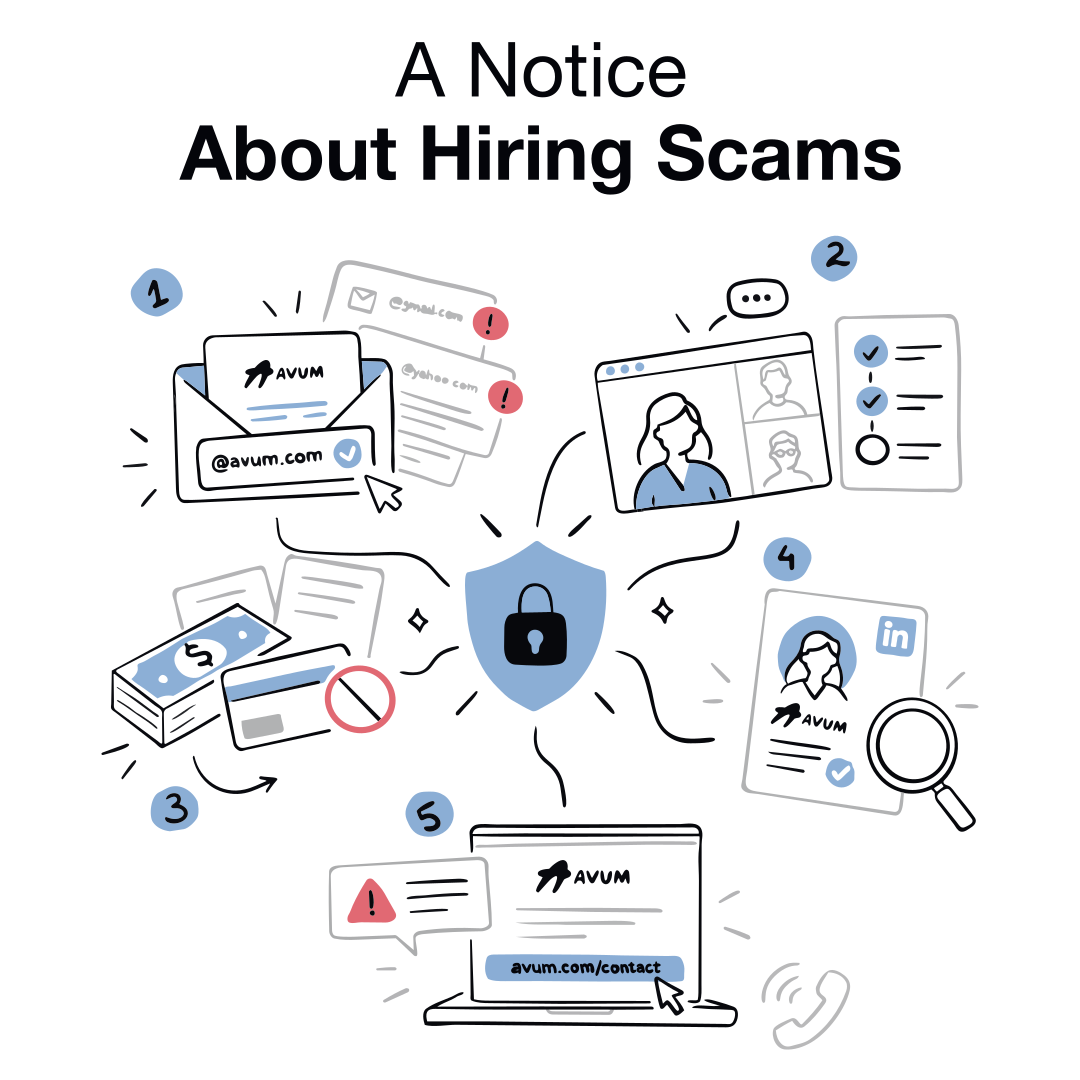
Steps for Recruitment Scams. 1. Verify it’s an official AVUM email. Messages from AVUM will come from @avum.com. 2. Expect a structured interview process. You’ll go through multiple steps such as a chat, video call, and skillor team interviews. 3. Never pay feesor deposit checks. AVUM will never ask you to payfor a job, deposit a check, or wiremoney for equipment. 4. Confirm recruitercredentials. Verify your recruiter on LinkedIn and make surethey work at AVUM. 5. Report suspicious outreach. If you receive a suspicious message,contact AVUM directly throughour official channels. avum.com/contact
At Avum, Inc., candidate security is a top priority. Here are 5 key indicators to ensure you are engaging with authentic Avum recruitment channels and protecting your personal data:
Verify Official @avum.com Email Domains
All legitimate communications from our recruitment team originate strictly from an official @avum.com email address. Be extremely cautious of messaging sent from free webmail services (such as Gmail, Yahoo, or Outlook) or lookalike domain variations. If you receive a suspicious communication claiming to represent Avum, do not click links, open attachments, or provide personal information. Contact Avum directly to verify its legitimacy.
Expect a Multi-Step Interview Process
Avum will never extend a job offer without conducting a formal, structured interview process involving direct engagement with our hiring managers and technical teams. If you receive an instantaneous offer based solely on a text chat or questionnaire, it is fraudulent.
Avum Will Never Demand Financial Commitments
We will never ask candidates to pay for application processing, background checks, technical assessment coaching, or onboarding materials. Furthermore, we will never send a check with instructions to deposit it and wirße funds back for home office supplies.
Confirm Recruiter Credentials on LinkedIn
When contacted by an individual on professional networks like LinkedIn who claims to represent Avum, verify that their profile links directly to our verified corporate page and reflects legitimate alignment with our staffing practices.
Report Suspicious Outreach Immediately
If you receive suspicious employment communications or wish to confirm the validity of an open role, contact us directly at avum.com/contact. If you have been defrauded or suspect identity theft because of an employment scam, please contact your local law enforcement agency for guidance.
Avum remains committed to maintaining a secure, transparent, and direct pathway for defense and technology professionals seeking to build the next generation of digital acquisition capabilities.
To pursue employment opportunities with us, please visit our official careers website at avum.com/careers
Read More

Avum Pairs Acquisition Experts with Best-In-Class Engineers to Transform the Acquisition Landscape
November 18, 2025Artificial Intelligence.
Big data.
Revolutionary FAR changes.
Federal Procurement Consolidation at GSA.
A New Acquisition Transformation Strategy from SECWAR.
Acquisition and procurement change is taking place at breakneck speed to equip warfighters with what they need downrange, and such change requires the right battle scars, qualifications, problem-solving abilities, and insights to unlock an advanced, digital acquisition environment.
Avum, Inc. knows a nexus of knowledge is needed to bring disruptive capabilities and business process efficiencies to government acquisition. This is why we have made a strategic focus on hiring seasoned acquisition and contracting talent to pair with our best-in-class engineering staff. Avum has built a team of expert procurement practitioners and program managers to bridge the worlds of acquisition practitioners and software development professionals. Our new acquisition and contracting subject matter expert (SME) team understands acquisition and procurement from the lens of many buying and selling organizations, and it knows the good, bad, and ugly of legacy and modern systems alike.
Our new SME team has decades of GOVCON experience, enabling our government customers to leverage deep domain knowledge and avoid pitfalls/costly mistakes as the Trump Administration seeks to effectively incorporate artificial intelligence and emerging technologies into building a more effective, data-driven, and unified acquisition lifecycle. While other firms may see a list of technical requirements, our team also sees real-world gaps, frustrations, and opportunities to shape better, more integrated capabilities and user experiences. Our team has been in the field, has written and negotiated contracts, and understands the “why” behind every click, form, and workflow. As we embed our SMEs within our agile development practices, we bring vision, economy, and street smarts to building the next generation of acquisition systems.
Our approach isn't just theoretical. It’s delivering tangible results in our work supporting the Deputy Assistant Secretary of the Navy for Procurement (DASN (P)), under the Assistant Secretary of the Navy for Research, Development and Acquisition (ASN (RDA)). We are central to a generational leap in modernizing procurement processes. We are helping to sunset the War Department's largest implementation of Procurement Desktop-Defense (PD2) within the Standard Procurement System by developing new capabilities and migrating trillions of dollars in legacy contracts' data. This massive undertaking is successful because we understand the intricate data structures and language of procurement from a contracting officer’s perspective.
By embedding deep domain knowledge into our agile development teams, we ensure that every solution is built with the end-user's reality in mind. We are not just fulfilling a statement of work; we are crafting a better experience for the thousands of acquisition professionals dedicated to supporting the warfighter.
Read More
Federated, Not Fractured: The Secret to Building a Truly Integrated Procurement Ecosystem Across Government
September 30, 2025The idea of a single, 'one-size-fits-all' solution for federal procurement is a long-outdated myth. True modernization, according to the experts at Avum, Inc., comes from embracing the complex reality of government work and fostering a collaborative, federated environment where different systems work in concert.
Central to Avum's approach is a deep-seated commitment to partnership. The company regularly collaborates with other vendors, including several without a formal business relationship, to deliver integrated solutions for its contracting customers. This philosophy demonstrates an understanding that the government's overall success is paramount, requiring a focus on teamwork over proprietary silos.
This collaborative spirit is evident in the company's work to improve DoD-wide procurement processes. Avum partners with other DoD and industry experts in contracting-adjacent disciplines like requirements management, financial management, and logistics to achieve this goal. Rather than replacing effective systems, Avum often works to extend capabilities provided by other government entities, including the Army, Air Force, and 20 Fourth Estate agencies.
The collaboration extends to a deep, technical level. Avum actively contributes code and low-code process models to other DoD partners in a collaborative effort to increase economy and efficiency in contract writing system development. This work is performed within a broader, federated environment integrating with essential government-wide platforms like the Federal Integrated Award Environment (IAE) and the DoD's Procurement Integrated Enterprise Environment.
For Avum, success is not measured by the footprint of its own software alone, but by the seamless operation of the entire government ecosystem. By fostering collaboration and integration across government and contractor teams, Avum is helping build a procurement environment that is truly federated, not fractured, ensuring all partners can contribute effectively to the mission.
Read More

Federal Acquisition Modernization: How Avum and Appian Accelerate Agency Outcomes
January 29, 2026At Avum, Inc., we’ve built our reputation on solving the complex technical hurdles of the Department of War (DoW). But as the landscape of federal acquisition shifts, the challenge isn’t just about technical capability. It's about velocity, interoperability, and fiscal responsibility.
As Congress increases oversight on military spending, the mandate is clear: all branches must save costs and eliminate the silos that slow us down. To meet this challenge, Avum has deepened its partnership with Appian.
By leveraging Appian’s low-code solutions, we aren’t just building applications. We are building the future of cross-service efficiency.
One Codebase, Multiple Missions
One of the primary drivers of our partnership is the ability to create shareable success. The congressional emphasis on modernizing government contract writing systems has created a unique opportunity for innovation.
We’ve already seen the impact of this approach. The adaptability of the Appian platform has made sharing code across DoW services instrumental in our progress. We have been able to leverage code created by the Navy, Army, Air Force, and the Defense Logistics Agency (DLA/4th Estate) in the ePS product. Conversely we have shared our development efforts for broader DoW use, an initiative that contributed to the DoW winning the GITEC award for Acquisition Innovation and Impact in 2025. With Appian, we can take this “write once, deploy many” philosophy to the next level. The sharing of code between the services ensures that every dollar spent on development benefits the entire Joint Force.
Solving the Complexity of Contracting
Federal contracting is one of the most document-heavy and workflow-intensive environments in the world and Appian is equipped with features and functionality uniquely suited for the full lifecycle of acquisition.
From the initial Purchase Requisition (PR) to solicitations, amendments, and final awards, the process is a maze of routing and compliance. Appian’s platform excels here due to a few unique capabilities:
Process Modeling: It is built to take complex inputs and ensure they are routed exactly where they need to go, maintaining a perfect audit trail.
Complex Document Handling: It simplifies the storage and management of the massive data sets and forms inherent in the Navy’s contracting process.
Rapid Iteration: The built-in tools allow us to move from a requirement to a functional workflow faster than traditional high-code methods ever could.
The Strategic Choice: Lessons from the Navy’s ePS
Choosing a platform is a high-stakes decision. Before launching our work on the Navy’s Electronic Procurement System (ePS), we participated in a feasibility study alongside the Assistant Secretary of the Navy for Research, Development, and Acquisition (ASN (RDA)) and the Deputy Assistant Secretary of the Navy for Procurement (DASN(P)).
During this feasibility study, we evaluated several alternatives, but landed on utilization of the Air Force’s CON-IT code base, which was built using the Appian AI-powered, low-code platform. In doing so, we were able to build and scale in the most efficient and cost effective way possible.
We chose to double down on Appian for three specific reasons:
User Accessibility: It is significantly easier for both our developers and the Navy’s non-technical subject matter experts to learn and operate.
Modern Integration: It integrates seamlessly with our AWS cloud environments and Java-based microservices.
Proven Foundation: By building on the Appian framework, we could modify existing success for the Navy rather than reinventing the wheel.
Looking Ahead
Our partnership with Appian is about more than just low-code. It’s about fulfilling our commitment to the warfighter. By reducing development time and enabling cross-service collaboration, we are ensuring that the Navy and its sister branches have the tools they need to stay agile in an increasingly complex world.
At Avum, we don’t just build software. We build the systems that power the mission. With Appian, we’re doing it faster and smarter than ever before.
Read More

Avum's Human-Centric UI/UX Design Approach
January 23, 2026Click here for the full whitepaper download
Part I - Our Philosophy
Introduction - A Human-Centric Approach to Digital Solutions
In today's rapidly changing technological landscape, a one-size fits all design approach is no longer feasible. Many digital solutions fail to meet their objectives not because of technical limitations but because they overlook the human being behind the screen as the most critical element. When workflows are forced to conform to rigid software, the result is often organizational fatigue, friction, and a failure to achieve optimal output.
At Avum, we believe the relationship between a user and their technology should be symbiotic and harmonious. We achieve this by matching the design of an application to the unique needs, goals, and workflows of its users. Our approach is built on a foundation of deep user research, agile methodologies that allow for constant evolution, and a core commitment to accessibility.
Leveraging Agile for Optimal Efficiency
Agile, as opposed to the commonly known waterfall development process, is more effective and efficient for many reasons. A main component of the agile methodology is the Sprint which is a fixed short period of time in which a development team works to complete a specific set of tasks. These tasks contribute to the incremental progress in the development, maintenance, or upgrading of a product.
In our approach, the UI/UX team is fully integrated into this cycle rather than working in a silo. Designers work closely with Product Owners to define user stories and with developers to ensure that the user interface remains intuitive as new features are added. Sprints allow these cross functional teams to collaborate on a more frequent basis and get more work done in a more effective manner. This collaboration consists of regular stand up meetings or Scrum meetings that often occur on a daily basis. During these sessions, designers and developers discuss current tasks, identify any bugs or blockers inhibiting development, and evaluate enhancements or feature requests sent in by users.
Sprints also include at least one planning session where the UI/UX lead helps prioritize the backlog based on user impact and technical feasibility. The backlog is the list of every task, feature, bug fix, or requirement needed to complete a project. It serves as the single source of truth for the work the team needs to perform. Additionally, Sprints include a review session in which team members can discuss what was accomplished, make suggestions for improvement, and recognize the achievements of other team members to enhance the overall strength of the team. This ensures that the design intent is maintained from the initial prototype through the final code.
The agile framework keeps all eyes on the prize and plays a key role in our ability to iterate based on real time feedback. Where the outdated waterfall method has limited venues for transformation, agile steps in to provide constant space for continuous improvement. Technology will always be rapidly changing and that means the needs of our end users will also be in a cycle of constant evolution.
The Importance of Human-Centric Design
We believe the core architecture of an application should align directly with the natural behaviors and cognitive needs of the human being behind the screen. For the relationship between an end user and their technology to be as harmonious and symbiotic as possible, we must first research the user behind the scenes at a level that goes beyond asking “What do you need to get done?”.
We need to understand pain points, roadblocks, and current systems being used while determining whether those tools are supporting the most optimal flow. We must also understand variables such as incentives, workflow rhythm, and the person behind the persona.
Avum's personalized design approach offers a single tailored entry point for each user group and design elements for visual and functional consistency across portals. Our intuitive design approach combined with consistent elements prevents organizational fatigue and increases satisfaction to help get more done in a shorter period of time. We strive for optimized output without compromising satisfaction.
A Commitment Beyond Compliance
We understand the regulations surrounding accessibility standards such as Section 508 and WCAG 2.1 AA and we aim to go beyond baseline fulfillment of these requirements. Our extensive user research has proven that a user-focused design optimized for the widest user set possible will yield the highest performance. Our team strives to create a more adaptive system capable of quickly incorporating future policy and program changes that result in a more efficient and effective government acquisition process.
Meeting standards is not considered a final stage objective - a means to simply check boxes off to maintain compliance. Using methods mentioned above, the Avum team incorporates accessibility from the planning phase onward and possesses the ability to modify, eliminate or update a feature or functionality that isn't delivering the forecasted results. Accessibility will always be at the forefront of our design and development process, rather than a task to cross off at the end.
Part II - Our Process in Action
The Avum Way - Our UI/UX Methodology
At Avum, our UI/UX process is designed to ensure that digital products are not only visually engaging but also intuitive, inclusive, and aligned with user needs. Our approach follows a structured, repeatable methodology that balances user-centered research with iterative design and testing. To move from high-level goals to a functional, user-centric application, our team follows a structured nine-step methodology:
1\. User Research
We begin by gathering insights directly from target users, SMEs and stakeholders. Through interviews, surveys, and contextual inquiry, we uncover user goals, behaviors, and challenges. This foundation ensures that our design decisions are rooted in real-world needs rather than assumptions.
User research consists of many different data types. Qualitative research can include findings that dive into the broader “why”, while quantitative research provides measurable insights that pinpoint data and use it to further refine a proposed solution. Feedback from user research is pivotal to success - which is why a large amount of time is dedicated to laying a scalable foundation.
2\. User Personas
Research findings are synthesized into personas — fictional yet evidence-based representations of core user groups. These personas provide alignment across the team by making user motivations and pain points tangible.
Persona findings can include data on polarizing scales like introversion vs. extroversion and how likely an individual is to work amongst other individuals on a team or take risks. We also aim to paint a picture of the character behind the screen. Our goal is to become well-versed in the systems within an individual that produce an outcome and figure out how to optimize the path of getting to the desired outcome.
3\. Empathy Mapping
We extend personas with empathy maps to better understand how users think, feel, say, and do within the product’s context. This exercise builds alignment and deepens our team’s understanding of user experiences.
Using user research to develop empathy maps is a step that goes beyond gathering insights. Its use in developing high-performing applications is critical. By gathering such critical evidence we can deduct and make inferences about how an end-user is likely to use a solution, outside of role-specific duties.
4\. User Journey Mapping
Next, we create journey maps to visualize the end-to-end user experience. These highlight touchpoints, emotions, and opportunities for improvement across different phases of interaction.
Collaboration is key in journey mapping, both internally and externally. This upfront investment helps us better understand the flow of an individual and not just from step 1-x in a platform, but from initial login to the long-term relationship. Gathering data about a user cannot be done in a silo - users are closely connected to other teams that contribute to success. We strive to make the crawl, walk and run stages as easy and seamless as possible and are able to do so by eliminating pain points along the way. These pain points include data load speed, ease in pulling reports and ability to visualize success metrics.
5\. User Flow Diagrams
To refine interactions, we build user flow diagrams that illustrate how users accomplish specific tasks within the system. These flows help us optimize navigation, minimize friction, and identify potential gaps before moving into design.
Think of these as your morning routine. What steps do you take to ensure optimal performance throughout the day? A small slip in the routine can impact subsequent events and that’s why we empower users to feel confident making their next move. Bright, work-flow buttons that signal next steps and infer that you're on the right track help to eliminate organizational fatigue. Additionally, illustrative icons that provide guidance on workflow orchestration can be a key contributor to success.
6\. Design & Prototype
With research and flows in place, we create wireframes and interactive prototypes. Early designs are kept low-fidelity to encourage exploration and feedback, then gradually evolve into high-fidelity mockups that capture visual design, branding, and accessibility standards.
7\. Usability Testing
Prototypes are tested with real users to evaluate clarity, efficiency, and satisfaction. Observations guide design refinements, ensuring that functionality aligns with user expectations and reduces cognitive load.
Once code has been implemented, we save plenty of space for user feedback. Technology is constantly evolving and that means that even if a design is perfect for today’s needs, there may be room for improvement in the near future. The goal of usability testing is to measure ease of use, learnability, satisfaction, and error rate.
8\. Implement
Validated designs are handed off with detailed specifications. We collaborate closely with development teams to ensure accurate translation of design intent into production-ready interfaces.
9\. Test, Learn, and Repeat
Post-launch, we monitor analytics, collect user feedback, and conduct A/B tests. Insights from this phase fuel continuous improvement — creating a cycle of iteration that keeps products relevant and user-centered.
Design has been and always will be an iterative process, both physical and digital. As technology morphs to fit current needs, so must design. Our phones, computers, tablets, etc., will continue to evolve and it is our passion to optimize design with day-to-day functionality.
Accessibility by Design
Accessibility is embedded into every phase of our UI/UX process. We design with the principle that equitable access is a baseline requirement, not an optional feature. Our standards align with WCAG 2.1 and ensure compliance with Section 508 for federal and enterprise projects.
Our practices include:
Inclusive Visual Design – All color palettes are tested for contrast ratios of at least 4.5:1.
Keyboard Navigation – Interfaces are fully operable without a mouse.
Screen Reader Compatibility – Semantic HTML, ARIA roles, and descriptive alt text are consistently applied.
Document & PDF Accessibility – Deliverables are tagged for logical reading order, heading hierarchy, and alternative text descriptions.
Assistive Technology Ready – We prep designs for screen readers, magnifiers, and voice navigation.
Compliance Audits – Internal and, where applicable, third-party audits confirm that experiences meet Section 508 requirements.
By embedding accessibility and compliance throughout discovery, design, testing, and implementation, we ensure our solutions serve the widest possible audience — including users with disabilities.
Case Study - Modernizing the Federal Acquisition Lifecycle
The federal acquisition process is governed by rigid regulatory milestones ranging from Requirements Development and Solicitation to Award and Closeout. Avum treats these milestones not as hurdles, but as data-driven touchpoints. By mapping our UI/UX flows directly to the Federal Acquisition Regulation (FAR) phases, we ensure that Contracting Officers and Program Managers are prompted with the right information at the exact moment a regulatory decision is required.
Our work on the Electronic Procurement System (ePS) for the Assistant Secretary of the Navy for Research Development and Acquisition (ASN (RDA)) and the Deputy Assistant Secretary of the Navy for Procurement (DASN(P)) serves as a primary example of this philosophy in action. Through the deep integration of design and policy, Avum transformed a series of disjointed administrative tasks into a streamlined, automated engine for mission success.
Eliminating Manual Data Entry through API Integration
Avum creates a fully connected ecosystem by redesigning architecture around independently deployable API-connected services. This approach breaks down the silos between disparate systems and eliminates redundant manual data entry. A notable success occurred during the Solicitation phase where users previously spent hours answering a series of contract related questions.
To minimize this burden, Avum integrated an API with the Clause Logic System (CLS) to gather elements that the system can pre-populate automatically. While some unique answers still require manual input, this update turned a process that previously took multiple hours to complete, into a step that now takes just minutes. This integration provides generous time-saving capabilities for the contracting lifecycle and ensures that acquisition professionals can complete their tasks with unprecedented efficiency.
Through Step 3 - Empathy Mapping, our team realized that manual data entry did more than just waste time; it was a primary source of stress and potential error for the person behind the screen. By investing in this API integration, we moved beyond baseline functionality to create a system that actively reduces stress and empowers users to focus on high-value decision-making.
Enhancing Workflow with Progressive Disclosure
Acquisition professionals often manage hundreds of Contract Line Item Numbers known as CLINs. In legacy systems, viewing and modifying these items required clicking into each individual item and waiting up to 15 seconds for a unique page to load. For a contract containing 400 line items this workflow was simply not feasible.
Applying the philosophy of progressive disclosure, Avum built an in-app pop up that generates immediately when a user clicks a line item. This allows users to scroll through and modify all CLINs as needed without leaving the main page. This initiative reduced a 15 second wait time to less than 1 second per item. We took this a step further by building a feature that enables users to import and export data via Excel. This allows users to manage multiple similar contracts by exporting data, making necessary adjustments in Excel, and reimporting the data to be reflected across other contracts.
This solution emerged from Step 5 - User Flow Diagrams, where we mapped the standard routine of an acquisition officer and realized that the existing workflow forced a high cognitive load for simple edits. By applying progressive disclosure, we ensured the technology kept users in a flow-state for as long as possible, rather than forcing them to stop and mentally process a maze of pages.
Optimizing Migration and System Performance
During the development of ePS, Avum was tasked with the migration of thousands of legacy PDF files. During the initial testing phase our team encountered processing times averaging 10 minutes per legacy contract for ingestion into the new system. Our team investigated the process model within our low-code development platform and uncovered that the pre-rendering of PDF files was consuming the most energy and time.
To increase efficiency and reduce costs our design and development teams removed PDF generation from the initial import process and built a component directly within the UI that allowed PDF rendering to be initiated by the end-user post-migration. This enhancement reduced the average processing time from 10 minutes to 3 minutes per legacy contract which resulted in quicker development speeds and significant cost savings for our government partners.
This shift was primarily driven by Step 9 - Test, Learn and Repeat, where we identified that the system’s backend energy was better spent on immediate user needs rather than background processing. By aligning the system’s performance with the user’s actual workflow rhythm, we eliminated a major source of organizational fatigue and replaced a technical hurdle with human-centric functionality.
Read More
How Hybrid Cloud Solutions Like EKS Anywhere Ensure Mission Continuity and Security for Government Systems
October 30, 2025In today's complex digital landscape, government agencies face the dual challenge of modernizing their IT infrastructure while upholding the strictest security and compliance standards. Meeting these demands requires a flexible, powerful, and secure approach to application deployment.
At Avum, Inc., we deliver on this need by combining our engineering expertise with seasoned, in-house procurement domain knowledge and policy-making experience. We strategically leverage a hybrid cloud strategy powered by Amazon Elastic Kubernetes Service (EKS) and EKS Anywhere. This allows us to provide robust, scalable, and secure solutions that ensure mission continuity for our government partners. This powerful combination allows us to masterfully orchestrate complex configurations and microservices capable of supporting over 250,000 end users across the globe (including in secure environments). This is achieved through a methodology that emphasizes end-user/product owner engagement to deliver best-in-class solutions.
A Unified Approach for Maximum Flexibility
The core of our strategy is consistency. We use Amazon EKS for cloud-based deployments and EKS Anywhere for on-premises configurations. This hybrid approach is powerful because it allows us to maintain a consistent operational model, regardless of where an application is running. By using the same Kubernetes tooling, APIs, and operational patterns across both environments , our development teams can iterate quickly while reducing challenges when moving from development to staging to production.
For government clients, this means:
Portability: Workloads and microservices can be moved between the cloud and on-premises data centers without needing extensive code or pipeline rewrites.
Adaptability: This flexibility allows us to adapt quickly to changing business and mission requirements , optimizing for performance, cost, and compliance. This capability reduces lock-in and preserves flexibility in how and where applications are deployed.
EKS Anywhere: A Timely and Cost-Effective Alternative to VMware
The IT landscape is shifting, and the recent acquisition of VMware by Broadcom has introduced significant uncertainty around future licensing models and price increases. Many government agencies and organizations are now actively re-evaluating their dependency on traditional virtualization platforms to avoid unpredictable costs and vendor lock-in.
This is precisely where Kubernetes with EKS Anywhere emerges as a compelling and modern alternative. It provides a clear path for agencies to modernize their on-premises workloads, moving from expensive, traditional virtual machines (VMs) to a more agile, portable container-based platform.
By migrating to Kubernetes EKS Anywhere, organizations can:
Mitigate Rising Costs: Escape the escalating licensing and support fees associated with the VMware ecosystem.
Embrace Modernization: Transition applications to Kubernetes, enabling microservices, improved scalability, and faster development cycles.
Maintain Consistency: Leverage the same consistent operational model and tooling as their cloud-based EKS workloads, reducing complexity and training overhead.
This move isn't just a cost-saving measure; it's a strategic step toward building more flexible, resilient, and future-proof systems that are not tied to a single, costly virtualization vendor.
Driving Agility and Mission Focus
A key advantage of using Amazon EKS is its managed control plane. Amazon handles the critical but time-consuming tasks of patching, scaling, and ensuring the availability of the Kubernetes control plane.
This EKS managed control plane fits seamlessly into Avum's hybrid Agile Scrum/Kanban development methodology. It frees our highly skilled engineering teams from routine cluster management so they can focus on delivering value and innovation. We often have multiple Scrum Teams working on modular pieces of a bigger project , and this approach supports them by reducing operational overhead. It enables faster iteration, as teams can spin up or tear down environments on-demand. This capability is critical for supporting rapid prototyping, automated testing, and our continuous delivery pipelines.
Uncompromising Security and Compliance
EKS Anywhere is a critical component for meeting the unique needs of government systems. For scenarios where regulatory, security, or latency requirements dictate that workloads must remain on-premises, EKS Anywhere brings the consistent Kubernetes experience of the cloud to a secure, local environment. This capability is essential for handling sensitive data and mission-critical applications that cannot be moved to a public cloud.
This ensures consistency and portability , allowing our developers and operations teams to use the same proven processes and tools across all environments, which reduces learning curves and maintains a high security posture.
By mastering this hybrid cloud technology and combining it with deep procurement domain knowledge and policy-making experience , Avum delivers solutions that are not only innovative but also fundamentally secure, resilient, and built to support the critical missions of our government partners for years to come.
Read MoreA Notice About Hiring Scams: Verify That It’s Really Us
September 29, 2026Beware of recruitment and employment scams! Got a message claiming to be from Avum? Before you respond, verify the email domain and know what to expect from us.
Some scammers may impersonate Avum, falsely claim to represent Avum, or make their communications appear to come from Avum in order to deceive job seekers.
Steps for Recruitment Scams. 1. Verify it’s an official AVUM email. Messages from AVUM will come from @avum.com. 2. Expect a structured interview process. You’ll go through multiple steps such as a chat, video call, and skillor team interviews. 3. Never pay feesor deposit checks. AVUM will never ask you to payfor a job, deposit a check, or wiremoney for equipment. 4. Confirm recruitercredentials. Verify your recruiter on LinkedIn and make surethey work at AVUM. 5. Report suspicious outreach. If you receive a suspicious message,contact AVUM directly throughour official channels. avum.com/contact
At Avum, Inc., candidate security is a top priority. Here are 5 key indicators to ensure you are engaging with authentic Avum recruitment channels and protecting your personal data:
Verify Official @avum.com Email Domains
All legitimate communications from our recruitment team originate strictly from an official @avum.com email address. Be extremely cautious of messaging sent from free webmail services (such as Gmail, Yahoo, or Outlook) or lookalike domain variations. If you receive a suspicious communication claiming to represent Avum, do not click links, open attachments, or provide personal information. Contact Avum directly to verify its legitimacy.
Expect a Multi-Step Interview Process
Avum will never extend a job offer without conducting a formal, structured interview process involving direct engagement with our hiring managers and technical teams. If you receive an instantaneous offer based solely on a text chat or questionnaire, it is fraudulent.
Avum Will Never Demand Financial Commitments
We will never ask candidates to pay for application processing, background checks, technical assessment coaching, or onboarding materials. Furthermore, we will never send a check with instructions to deposit it and wirße funds back for home office supplies.
Confirm Recruiter Credentials on LinkedIn
When contacted by an individual on professional networks like LinkedIn who claims to represent Avum, verify that their profile links directly to our verified corporate page and reflects legitimate alignment with our staffing practices.
Report Suspicious Outreach Immediately
If you receive suspicious employment communications or wish to confirm the validity of an open role, contact us directly at avum.com/contact. If you have been defrauded or suspect identity theft because of an employment scam, please contact your local law enforcement agency for guidance.
Avum remains committed to maintaining a secure, transparent, and direct pathway for defense and technology professionals seeking to build the next generation of digital acquisition capabilities.
To pursue employment opportunities with us, please visit our official careers website at avum.com/careers
Read MoreFederal Acquisition Modernization: How Avum and Appian Accelerate Agency Outcomes
January 29, 2026At Avum, Inc., we’ve built our reputation on solving the complex technical hurdles of the Department of War (DoW). But as the landscape of federal acquisition shifts, the challenge isn’t just about technical capability. It's about velocity, interoperability, and fiscal responsibility.
As Congress increases oversight on military spending, the mandate is clear: all branches must save costs and eliminate the silos that slow us down. To meet this challenge, Avum has deepened its partnership with Appian.
By leveraging Appian’s low-code solutions, we aren’t just building applications. We are building the future of cross-service efficiency.
One Codebase, Multiple Missions
One of the primary drivers of our partnership is the ability to create shareable success. The congressional emphasis on modernizing government contract writing systems has created a unique opportunity for innovation.
We’ve already seen the impact of this approach. The adaptability of the Appian platform has made sharing code across DoW services instrumental in our progress. We have been able to leverage code created by the Navy, Army, Air Force, and the Defense Logistics Agency (DLA/4th Estate) in the ePS product. Conversely we have shared our development efforts for broader DoW use, an initiative that contributed to the DoW winning the GITEC award for Acquisition Innovation and Impact in 2025. With Appian, we can take this “write once, deploy many” philosophy to the next level. The sharing of code between the services ensures that every dollar spent on development benefits the entire Joint Force.
Solving the Complexity of Contracting
Federal contracting is one of the most document-heavy and workflow-intensive environments in the world and Appian is equipped with features and functionality uniquely suited for the full lifecycle of acquisition.
From the initial Purchase Requisition (PR) to solicitations, amendments, and final awards, the process is a maze of routing and compliance. Appian’s platform excels here due to a few unique capabilities:
Process Modeling: It is built to take complex inputs and ensure they are routed exactly where they need to go, maintaining a perfect audit trail.
Complex Document Handling: It simplifies the storage and management of the massive data sets and forms inherent in the Navy’s contracting process.
Rapid Iteration: The built-in tools allow us to move from a requirement to a functional workflow faster than traditional high-code methods ever could.
The Strategic Choice: Lessons from the Navy’s ePS
Choosing a platform is a high-stakes decision. Before launching our work on the Navy’s Electronic Procurement System (ePS), we participated in a feasibility study alongside the Assistant Secretary of the Navy for Research, Development, and Acquisition (ASN (RDA)) and the Deputy Assistant Secretary of the Navy for Procurement (DASN(P)).
During this feasibility study, we evaluated several alternatives, but landed on utilization of the Air Force’s CON-IT code base, which was built using the Appian AI-powered, low-code platform. In doing so, we were able to build and scale in the most efficient and cost effective way possible.
We chose to double down on Appian for three specific reasons:
User Accessibility: It is significantly easier for both our developers and the Navy’s non-technical subject matter experts to learn and operate.
Modern Integration: It integrates seamlessly with our AWS cloud environments and Java-based microservices.
Proven Foundation: By building on the Appian framework, we could modify existing success for the Navy rather than reinventing the wheel.
Looking Ahead
Our partnership with Appian is about more than just low-code. It’s about fulfilling our commitment to the warfighter. By reducing development time and enabling cross-service collaboration, we are ensuring that the Navy and its sister branches have the tools they need to stay agile in an increasingly complex world.
At Avum, we don’t just build software. We build the systems that power the mission. With Appian, we’re doing it faster and smarter than ever before.
Read MoreAvum's Human-Centric UI/UX Design Approach
January 23, 2026Click here for the full whitepaper download
Part I - Our Philosophy
Introduction - A Human-Centric Approach to Digital Solutions
In today's rapidly changing technological landscape, a one-size fits all design approach is no longer feasible. Many digital solutions fail to meet their objectives not because of technical limitations but because they overlook the human being behind the screen as the most critical element. When workflows are forced to conform to rigid software, the result is often organizational fatigue, friction, and a failure to achieve optimal output.
At Avum, we believe the relationship between a user and their technology should be symbiotic and harmonious. We achieve this by matching the design of an application to the unique needs, goals, and workflows of its users. Our approach is built on a foundation of deep user research, agile methodologies that allow for constant evolution, and a core commitment to accessibility.
Leveraging Agile for Optimal Efficiency
Agile, as opposed to the commonly known waterfall development process, is more effective and efficient for many reasons. A main component of the agile methodology is the Sprint which is a fixed short period of time in which a development team works to complete a specific set of tasks. These tasks contribute to the incremental progress in the development, maintenance, or upgrading of a product.
In our approach, the UI/UX team is fully integrated into this cycle rather than working in a silo. Designers work closely with Product Owners to define user stories and with developers to ensure that the user interface remains intuitive as new features are added. Sprints allow these cross functional teams to collaborate on a more frequent basis and get more work done in a more effective manner. This collaboration consists of regular stand up meetings or Scrum meetings that often occur on a daily basis. During these sessions, designers and developers discuss current tasks, identify any bugs or blockers inhibiting development, and evaluate enhancements or feature requests sent in by users.
Sprints also include at least one planning session where the UI/UX lead helps prioritize the backlog based on user impact and technical feasibility. The backlog is the list of every task, feature, bug fix, or requirement needed to complete a project. It serves as the single source of truth for the work the team needs to perform. Additionally, Sprints include a review session in which team members can discuss what was accomplished, make suggestions for improvement, and recognize the achievements of other team members to enhance the overall strength of the team. This ensures that the design intent is maintained from the initial prototype through the final code.
The agile framework keeps all eyes on the prize and plays a key role in our ability to iterate based on real time feedback. Where the outdated waterfall method has limited venues for transformation, agile steps in to provide constant space for continuous improvement. Technology will always be rapidly changing and that means the needs of our end users will also be in a cycle of constant evolution.
The Importance of Human-Centric Design
We believe the core architecture of an application should align directly with the natural behaviors and cognitive needs of the human being behind the screen. For the relationship between an end user and their technology to be as harmonious and symbiotic as possible, we must first research the user behind the scenes at a level that goes beyond asking “What do you need to get done?”.
We need to understand pain points, roadblocks, and current systems being used while determining whether those tools are supporting the most optimal flow. We must also understand variables such as incentives, workflow rhythm, and the person behind the persona.
Avum's personalized design approach offers a single tailored entry point for each user group and design elements for visual and functional consistency across portals. Our intuitive design approach combined with consistent elements prevents organizational fatigue and increases satisfaction to help get more done in a shorter period of time. We strive for optimized output without compromising satisfaction.
A Commitment Beyond Compliance
We understand the regulations surrounding accessibility standards such as Section 508 and WCAG 2.1 AA and we aim to go beyond baseline fulfillment of these requirements. Our extensive user research has proven that a user-focused design optimized for the widest user set possible will yield the highest performance. Our team strives to create a more adaptive system capable of quickly incorporating future policy and program changes that result in a more efficient and effective government acquisition process.
Meeting standards is not considered a final stage objective - a means to simply check boxes off to maintain compliance. Using methods mentioned above, the Avum team incorporates accessibility from the planning phase onward and possesses the ability to modify, eliminate or update a feature or functionality that isn't delivering the forecasted results. Accessibility will always be at the forefront of our design and development process, rather than a task to cross off at the end.
Part II - Our Process in Action
The Avum Way - Our UI/UX Methodology
At Avum, our UI/UX process is designed to ensure that digital products are not only visually engaging but also intuitive, inclusive, and aligned with user needs. Our approach follows a structured, repeatable methodology that balances user-centered research with iterative design and testing. To move from high-level goals to a functional, user-centric application, our team follows a structured nine-step methodology:
1\. User Research
We begin by gathering insights directly from target users, SMEs and stakeholders. Through interviews, surveys, and contextual inquiry, we uncover user goals, behaviors, and challenges. This foundation ensures that our design decisions are rooted in real-world needs rather than assumptions.
User research consists of many different data types. Qualitative research can include findings that dive into the broader “why”, while quantitative research provides measurable insights that pinpoint data and use it to further refine a proposed solution. Feedback from user research is pivotal to success - which is why a large amount of time is dedicated to laying a scalable foundation.
2\. User Personas
Research findings are synthesized into personas — fictional yet evidence-based representations of core user groups. These personas provide alignment across the team by making user motivations and pain points tangible.
Persona findings can include data on polarizing scales like introversion vs. extroversion and how likely an individual is to work amongst other individuals on a team or take risks. We also aim to paint a picture of the character behind the screen. Our goal is to become well-versed in the systems within an individual that produce an outcome and figure out how to optimize the path of getting to the desired outcome.
3\. Empathy Mapping
We extend personas with empathy maps to better understand how users think, feel, say, and do within the product’s context. This exercise builds alignment and deepens our team’s understanding of user experiences.
Using user research to develop empathy maps is a step that goes beyond gathering insights. Its use in developing high-performing applications is critical. By gathering such critical evidence we can deduct and make inferences about how an end-user is likely to use a solution, outside of role-specific duties.
4\. User Journey Mapping
Next, we create journey maps to visualize the end-to-end user experience. These highlight touchpoints, emotions, and opportunities for improvement across different phases of interaction.
Collaboration is key in journey mapping, both internally and externally. This upfront investment helps us better understand the flow of an individual and not just from step 1-x in a platform, but from initial login to the long-term relationship. Gathering data about a user cannot be done in a silo - users are closely connected to other teams that contribute to success. We strive to make the crawl, walk and run stages as easy and seamless as possible and are able to do so by eliminating pain points along the way. These pain points include data load speed, ease in pulling reports and ability to visualize success metrics.
5\. User Flow Diagrams
To refine interactions, we build user flow diagrams that illustrate how users accomplish specific tasks within the system. These flows help us optimize navigation, minimize friction, and identify potential gaps before moving into design.
Think of these as your morning routine. What steps do you take to ensure optimal performance throughout the day? A small slip in the routine can impact subsequent events and that’s why we empower users to feel confident making their next move. Bright, work-flow buttons that signal next steps and infer that you're on the right track help to eliminate organizational fatigue. Additionally, illustrative icons that provide guidance on workflow orchestration can be a key contributor to success.
6\. Design & Prototype
With research and flows in place, we create wireframes and interactive prototypes. Early designs are kept low-fidelity to encourage exploration and feedback, then gradually evolve into high-fidelity mockups that capture visual design, branding, and accessibility standards.
7\. Usability Testing
Prototypes are tested with real users to evaluate clarity, efficiency, and satisfaction. Observations guide design refinements, ensuring that functionality aligns with user expectations and reduces cognitive load.
Once code has been implemented, we save plenty of space for user feedback. Technology is constantly evolving and that means that even if a design is perfect for today’s needs, there may be room for improvement in the near future. The goal of usability testing is to measure ease of use, learnability, satisfaction, and error rate.
8\. Implement
Validated designs are handed off with detailed specifications. We collaborate closely with development teams to ensure accurate translation of design intent into production-ready interfaces.
9\. Test, Learn, and Repeat
Post-launch, we monitor analytics, collect user feedback, and conduct A/B tests. Insights from this phase fuel continuous improvement — creating a cycle of iteration that keeps products relevant and user-centered.
Design has been and always will be an iterative process, both physical and digital. As technology morphs to fit current needs, so must design. Our phones, computers, tablets, etc., will continue to evolve and it is our passion to optimize design with day-to-day functionality.
Accessibility by Design
Accessibility is embedded into every phase of our UI/UX process. We design with the principle that equitable access is a baseline requirement, not an optional feature. Our standards align with WCAG 2.1 and ensure compliance with Section 508 for federal and enterprise projects.
Our practices include:
Inclusive Visual Design – All color palettes are tested for contrast ratios of at least 4.5:1.
Keyboard Navigation – Interfaces are fully operable without a mouse.
Screen Reader Compatibility – Semantic HTML, ARIA roles, and descriptive alt text are consistently applied.
Document & PDF Accessibility – Deliverables are tagged for logical reading order, heading hierarchy, and alternative text descriptions.
Assistive Technology Ready – We prep designs for screen readers, magnifiers, and voice navigation.
Compliance Audits – Internal and, where applicable, third-party audits confirm that experiences meet Section 508 requirements.
By embedding accessibility and compliance throughout discovery, design, testing, and implementation, we ensure our solutions serve the widest possible audience — including users with disabilities.
Case Study - Modernizing the Federal Acquisition Lifecycle
The federal acquisition process is governed by rigid regulatory milestones ranging from Requirements Development and Solicitation to Award and Closeout. Avum treats these milestones not as hurdles, but as data-driven touchpoints. By mapping our UI/UX flows directly to the Federal Acquisition Regulation (FAR) phases, we ensure that Contracting Officers and Program Managers are prompted with the right information at the exact moment a regulatory decision is required.
Our work on the Electronic Procurement System (ePS) for the Assistant Secretary of the Navy for Research Development and Acquisition (ASN (RDA)) and the Deputy Assistant Secretary of the Navy for Procurement (DASN(P)) serves as a primary example of this philosophy in action. Through the deep integration of design and policy, Avum transformed a series of disjointed administrative tasks into a streamlined, automated engine for mission success.
Eliminating Manual Data Entry through API Integration
Avum creates a fully connected ecosystem by redesigning architecture around independently deployable API-connected services. This approach breaks down the silos between disparate systems and eliminates redundant manual data entry. A notable success occurred during the Solicitation phase where users previously spent hours answering a series of contract related questions.
To minimize this burden, Avum integrated an API with the Clause Logic System (CLS) to gather elements that the system can pre-populate automatically. While some unique answers still require manual input, this update turned a process that previously took multiple hours to complete, into a step that now takes just minutes. This integration provides generous time-saving capabilities for the contracting lifecycle and ensures that acquisition professionals can complete their tasks with unprecedented efficiency.
Through Step 3 - Empathy Mapping, our team realized that manual data entry did more than just waste time; it was a primary source of stress and potential error for the person behind the screen. By investing in this API integration, we moved beyond baseline functionality to create a system that actively reduces stress and empowers users to focus on high-value decision-making.
Enhancing Workflow with Progressive Disclosure
Acquisition professionals often manage hundreds of Contract Line Item Numbers known as CLINs. In legacy systems, viewing and modifying these items required clicking into each individual item and waiting up to 15 seconds for a unique page to load. For a contract containing 400 line items this workflow was simply not feasible.
Applying the philosophy of progressive disclosure, Avum built an in-app pop up that generates immediately when a user clicks a line item. This allows users to scroll through and modify all CLINs as needed without leaving the main page. This initiative reduced a 15 second wait time to less than 1 second per item. We took this a step further by building a feature that enables users to import and export data via Excel. This allows users to manage multiple similar contracts by exporting data, making necessary adjustments in Excel, and reimporting the data to be reflected across other contracts.
This solution emerged from Step 5 - User Flow Diagrams, where we mapped the standard routine of an acquisition officer and realized that the existing workflow forced a high cognitive load for simple edits. By applying progressive disclosure, we ensured the technology kept users in a flow-state for as long as possible, rather than forcing them to stop and mentally process a maze of pages.
Optimizing Migration and System Performance
During the development of ePS, Avum was tasked with the migration of thousands of legacy PDF files. During the initial testing phase our team encountered processing times averaging 10 minutes per legacy contract for ingestion into the new system. Our team investigated the process model within our low-code development platform and uncovered that the pre-rendering of PDF files was consuming the most energy and time.
To increase efficiency and reduce costs our design and development teams removed PDF generation from the initial import process and built a component directly within the UI that allowed PDF rendering to be initiated by the end-user post-migration. This enhancement reduced the average processing time from 10 minutes to 3 minutes per legacy contract which resulted in quicker development speeds and significant cost savings for our government partners.
This shift was primarily driven by Step 9 - Test, Learn and Repeat, where we identified that the system’s backend energy was better spent on immediate user needs rather than background processing. By aligning the system’s performance with the user’s actual workflow rhythm, we eliminated a major source of organizational fatigue and replaced a technical hurdle with human-centric functionality.
Read MoreAvum Pairs Acquisition Experts with Best-In-Class Engineers to Transform the Acquisition Landscape
November 18, 2025Artificial Intelligence.
Big data.
Revolutionary FAR changes.
Federal Procurement Consolidation at GSA.
A New Acquisition Transformation Strategy from SECWAR.
Acquisition and procurement change is taking place at breakneck speed to equip warfighters with what they need downrange, and such change requires the right battle scars, qualifications, problem-solving abilities, and insights to unlock an advanced, digital acquisition environment.
Avum, Inc. knows a nexus of knowledge is needed to bring disruptive capabilities and business process efficiencies to government acquisition. This is why we have made a strategic focus on hiring seasoned acquisition and contracting talent to pair with our best-in-class engineering staff. Avum has built a team of expert procurement practitioners and program managers to bridge the worlds of acquisition practitioners and software development professionals. Our new acquisition and contracting subject matter expert (SME) team understands acquisition and procurement from the lens of many buying and selling organizations, and it knows the good, bad, and ugly of legacy and modern systems alike.
Our new SME team has decades of GOVCON experience, enabling our government customers to leverage deep domain knowledge and avoid pitfalls/costly mistakes as the Trump Administration seeks to effectively incorporate artificial intelligence and emerging technologies into building a more effective, data-driven, and unified acquisition lifecycle. While other firms may see a list of technical requirements, our team also sees real-world gaps, frustrations, and opportunities to shape better, more integrated capabilities and user experiences. Our team has been in the field, has written and negotiated contracts, and understands the “why” behind every click, form, and workflow. As we embed our SMEs within our agile development practices, we bring vision, economy, and street smarts to building the next generation of acquisition systems.
Our approach isn't just theoretical. It’s delivering tangible results in our work supporting the Deputy Assistant Secretary of the Navy for Procurement (DASN (P)), under the Assistant Secretary of the Navy for Research, Development and Acquisition (ASN (RDA)). We are central to a generational leap in modernizing procurement processes. We are helping to sunset the War Department's largest implementation of Procurement Desktop-Defense (PD2) within the Standard Procurement System by developing new capabilities and migrating trillions of dollars in legacy contracts' data. This massive undertaking is successful because we understand the intricate data structures and language of procurement from a contracting officer’s perspective.
By embedding deep domain knowledge into our agile development teams, we ensure that every solution is built with the end-user's reality in mind. We are not just fulfilling a statement of work; we are crafting a better experience for the thousands of acquisition professionals dedicated to supporting the warfighter.
Read MoreHow Hybrid Cloud Solutions Like EKS Anywhere Ensure Mission Continuity and Security for Government Systems
October 30, 2025In today's complex digital landscape, government agencies face the dual challenge of modernizing their IT infrastructure while upholding the strictest security and compliance standards. Meeting these demands requires a flexible, powerful, and secure approach to application deployment.
At Avum, Inc., we deliver on this need by combining our engineering expertise with seasoned, in-house procurement domain knowledge and policy-making experience. We strategically leverage a hybrid cloud strategy powered by Amazon Elastic Kubernetes Service (EKS) and EKS Anywhere. This allows us to provide robust, scalable, and secure solutions that ensure mission continuity for our government partners. This powerful combination allows us to masterfully orchestrate complex configurations and microservices capable of supporting over 250,000 end users across the globe (including in secure environments). This is achieved through a methodology that emphasizes end-user/product owner engagement to deliver best-in-class solutions.
A Unified Approach for Maximum Flexibility
The core of our strategy is consistency. We use Amazon EKS for cloud-based deployments and EKS Anywhere for on-premises configurations. This hybrid approach is powerful because it allows us to maintain a consistent operational model, regardless of where an application is running. By using the same Kubernetes tooling, APIs, and operational patterns across both environments , our development teams can iterate quickly while reducing challenges when moving from development to staging to production.
For government clients, this means:
Portability: Workloads and microservices can be moved between the cloud and on-premises data centers without needing extensive code or pipeline rewrites.
Adaptability: This flexibility allows us to adapt quickly to changing business and mission requirements , optimizing for performance, cost, and compliance. This capability reduces lock-in and preserves flexibility in how and where applications are deployed.
EKS Anywhere: A Timely and Cost-Effective Alternative to VMware
The IT landscape is shifting, and the recent acquisition of VMware by Broadcom has introduced significant uncertainty around future licensing models and price increases. Many government agencies and organizations are now actively re-evaluating their dependency on traditional virtualization platforms to avoid unpredictable costs and vendor lock-in.
This is precisely where Kubernetes with EKS Anywhere emerges as a compelling and modern alternative. It provides a clear path for agencies to modernize their on-premises workloads, moving from expensive, traditional virtual machines (VMs) to a more agile, portable container-based platform.
By migrating to Kubernetes EKS Anywhere, organizations can:
Mitigate Rising Costs: Escape the escalating licensing and support fees associated with the VMware ecosystem.
Embrace Modernization: Transition applications to Kubernetes, enabling microservices, improved scalability, and faster development cycles.
Maintain Consistency: Leverage the same consistent operational model and tooling as their cloud-based EKS workloads, reducing complexity and training overhead.
This move isn't just a cost-saving measure; it's a strategic step toward building more flexible, resilient, and future-proof systems that are not tied to a single, costly virtualization vendor.
Driving Agility and Mission Focus
A key advantage of using Amazon EKS is its managed control plane. Amazon handles the critical but time-consuming tasks of patching, scaling, and ensuring the availability of the Kubernetes control plane.
This EKS managed control plane fits seamlessly into Avum's hybrid Agile Scrum/Kanban development methodology. It frees our highly skilled engineering teams from routine cluster management so they can focus on delivering value and innovation. We often have multiple Scrum Teams working on modular pieces of a bigger project , and this approach supports them by reducing operational overhead. It enables faster iteration, as teams can spin up or tear down environments on-demand. This capability is critical for supporting rapid prototyping, automated testing, and our continuous delivery pipelines.
Uncompromising Security and Compliance
EKS Anywhere is a critical component for meeting the unique needs of government systems. For scenarios where regulatory, security, or latency requirements dictate that workloads must remain on-premises, EKS Anywhere brings the consistent Kubernetes experience of the cloud to a secure, local environment. This capability is essential for handling sensitive data and mission-critical applications that cannot be moved to a public cloud.
This ensures consistency and portability , allowing our developers and operations teams to use the same proven processes and tools across all environments, which reduces learning curves and maintains a high security posture.
By mastering this hybrid cloud technology and combining it with deep procurement domain knowledge and policy-making experience , Avum delivers solutions that are not only innovative but also fundamentally secure, resilient, and built to support the critical missions of our government partners for years to come.
Read MoreFederated, Not Fractured: The Secret to Building a Truly Integrated Procurement Ecosystem Across Government
September 30, 2025The idea of a single, 'one-size-fits-all' solution for federal procurement is a long-outdated myth. True modernization, according to the experts at Avum, Inc., comes from embracing the complex reality of government work and fostering a collaborative, federated environment where different systems work in concert.
Central to Avum's approach is a deep-seated commitment to partnership. The company regularly collaborates with other vendors, including several without a formal business relationship, to deliver integrated solutions for its contracting customers. This philosophy demonstrates an understanding that the government's overall success is paramount, requiring a focus on teamwork over proprietary silos.
This collaborative spirit is evident in the company's work to improve DoD-wide procurement processes. Avum partners with other DoD and industry experts in contracting-adjacent disciplines like requirements management, financial management, and logistics to achieve this goal. Rather than replacing effective systems, Avum often works to extend capabilities provided by other government entities, including the Army, Air Force, and 20 Fourth Estate agencies.
The collaboration extends to a deep, technical level. Avum actively contributes code and low-code process models to other DoD partners in a collaborative effort to increase economy and efficiency in contract writing system development. This work is performed within a broader, federated environment integrating with essential government-wide platforms like the Federal Integrated Award Environment (IAE) and the DoD's Procurement Integrated Enterprise Environment.
For Avum, success is not measured by the footprint of its own software alone, but by the seamless operation of the entire government ecosystem. By fostering collaboration and integration across government and contractor teams, Avum is helping build a procurement environment that is truly federated, not fractured, ensuring all partners can contribute effectively to the mission.
Read More